
Compare home elevators side by side
Eleven models, one table. Capacity, how many floors, footprint, what has to be built, and roughly where each lands on cost. Then call us and we will tell you which two or three fit your house.
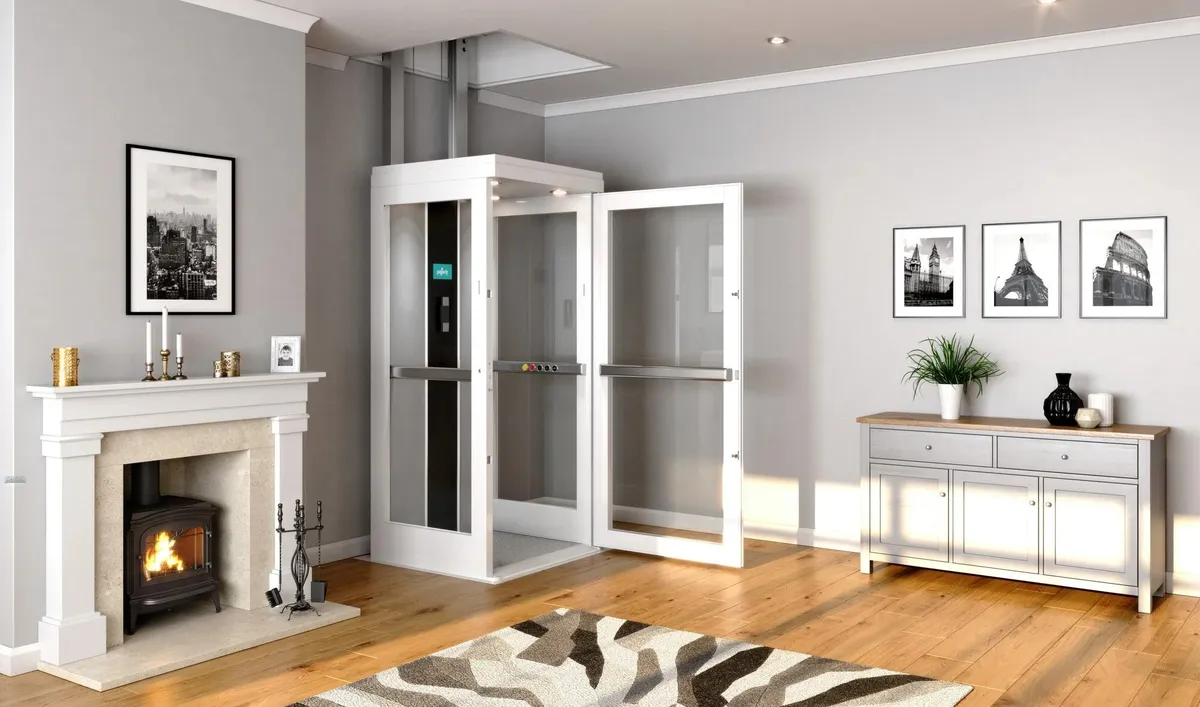
| Model | Type | Stops | Travel | Capacity | Footprint | Construction | Power | Relative cost |
|---|---|---|---|---|---|---|---|---|
| Pollock shaftless | Shaftless, through floor | 2 | Up to 14 ft | 500 lb | 31 x 43 to 43 x 62 in | None (floor opening) | 115V, 20A | Lowest |
| PVE30 | Pneumatic tube | 2 to 5 | Up to 50 ft | 350 lb | 30 in round | None (floor opening or balcony) | 220V, 25A | Low |
| PVE37 | Pneumatic tube | 2 to 5 | Up to 50 ft | 450 lb | 37 in round | None (floor opening or balcony) | 220V, 25A | Low |
| PVE52 | Pneumatic tube, wheelchair | 2 to 5 | Up to 50 ft | 525 lb | 52 in round | None (floor opening or balcony) | 220V, 25A | Medium |
| PVE Cube | Pneumatic, square | 2 to 3 | Up to 35 ft | 450 lb | 36 x 36 in | None (floor opening) | 220V | Low |
| Savaria Telecab | Through floor cab lift | 2 | Up to 23 ft | 500 lb | 30 x 46 to 32 x 54 in | Floor cutout, support wall | Standard | Low |
| Savaria Telecab17 | Through floor cab lift | 2 | Up to 23 ft | 845 lb | 30 x 46 or 36 x 54 in | Floor cutout, support wall | Standard | Medium |
| Savaria Eclipse | Traditional, chain drive, machine-room-less | Up to 6 | Up to 50 ft | 950 lb | 36 x 48 to 40 x 54 in cab | Hoistway, 8 in pit | Dedicated | Medium to high |
| Savaria Vuelift | Glass, hoistway included | Up to 6 | Up to 50 ft | 840 lb | Round or octagonal | Floor openings; hoistway is part of the unit | Dedicated | High |
| Savaria Infinity | Traditional, hydraulic | Up to 6 | Up to 50 ft | 1,000 to 1,400 lb | Multiple cab sizes | Hoistway, pit, machine room | 208V 3-phase or 230V | High |
| Savaria Zenith | Traditional, traction, machine-room-less | Up to 6 | Up to 60 ft | 1,400 lb | Multiple cab sizes | Hoistway, 10 in pit, 108 in overhead | 208V 3-phase or 240V | High |
Capacities and travel are manufacturer ratings and can be limited by local code. "Relative cost" is the installed project including typical site work, not the elevator alone. We will put a real number on it after a visit.
How we would narrow it down for you
Two floors, existing home, want it done quickly: Pollock or PVE. Pollock if you want a closed cab and a standard circuit; PVE if you like the glass tube and may want three or more stops someday.
Wheelchair user: PVE52, Pollock wheelchair size, Telecab17, or a traditional Savaria cab. The cab size and door width decide it, so bring the chair's measurements to the consultation.
New construction or a major renovation: Savaria Eclipse is the workhorse. Zenith if you want the quietest ride and 1,400 lb. Infinity if a machine room is available and you want hydraulic smoothness.
Want it to be the feature of the house: Vuelift, or a PVE in a two-story foyer.
Still unsure? Our home elevators overview explains the three types, and the video page shows several of them running.
Questions we hear every week
Which home elevator is the cheapest to install?
Usually the Pollock shaftless elevator or a PVE30, because neither needs a hoistway, pit, or machine room. The elevator itself is a smaller part of the cost than people expect; construction is what moves the total, and these two need the least.
Which one fits a wheelchair?
The PVE52, the Pollock in its wheelchair-accessible size, the Telecab17 in the 36 by 54 cab, and every traditional Savaria cab. The PVE30 and PVE37 are for a standing or seated passenger, with the PVE37 fitting a walker or a small transport chair.
Which is the quietest?
The Savaria Infinity, with its submersible hydraulic pump, and the Zenith with its traction drive. Among the low-construction options, the Pollock is noticeably quiet. PVE elevators make a sound like a vacuum when the turbines run, which some people like and some do not; we can show you one running.
Can you put an elevator in an existing home?
Yes. Most of our elevator work is in existing homes. Shaftless and pneumatic models were designed for exactly that. Traditional cabs go into existing homes too, usually in stacked closets or an addition on the outside wall.
Recent work near you
Every photo here is one of our own installations. No stock images, no staged showrooms.
Ready to talk it through?
Call and you will reach a person who installs these for a living. Or request a free in-home consultation and we will come to you, measure, and give you a written price with no pressure.